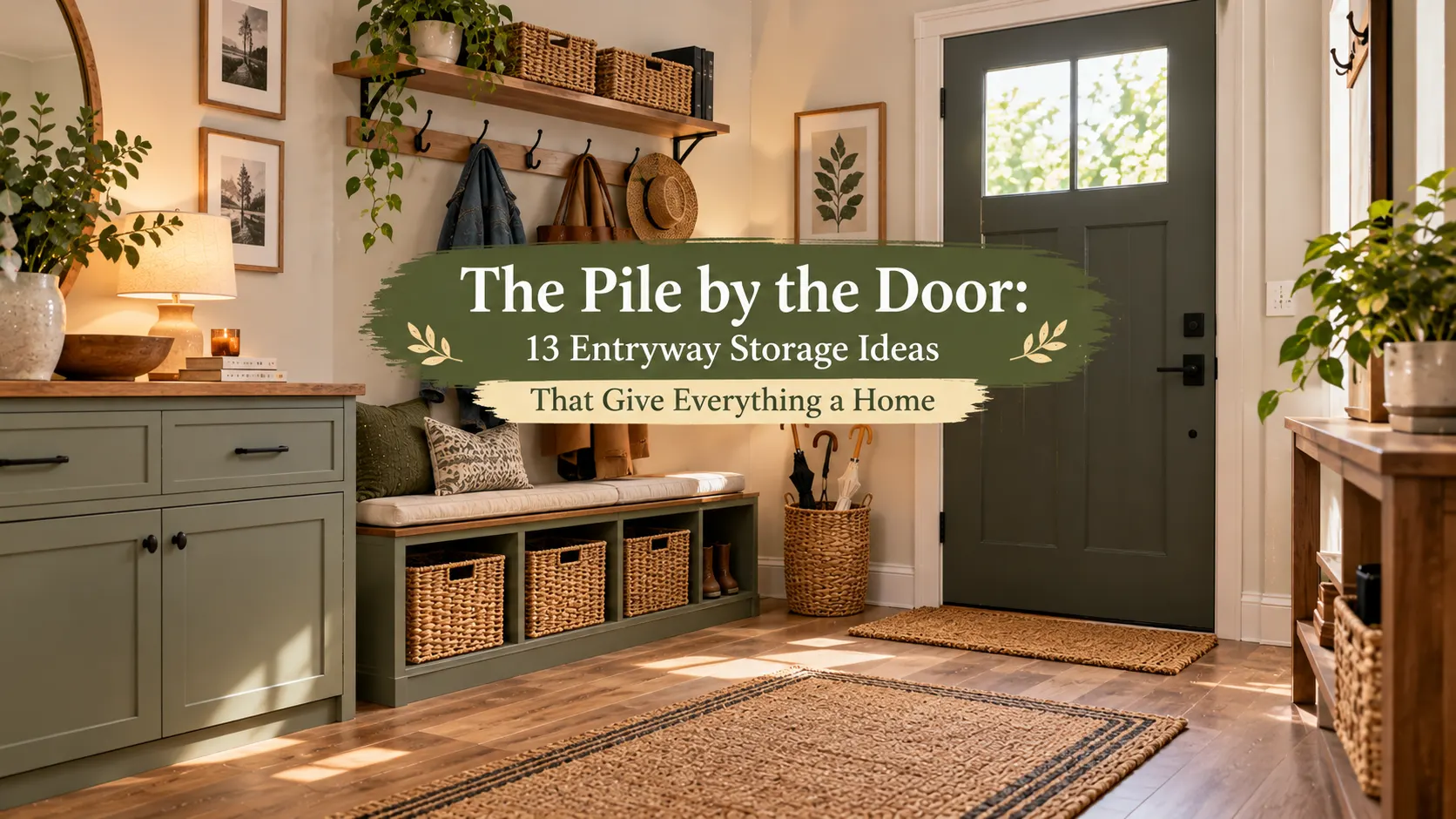
The Pile by the Door: 13 Entryway Storage Ideas That Give Everything a Home
Picture the floor just inside a busy front door on a weeknight. Two pairs of sneakers, one muddy boot, a school bag on its side, a stack of mail, a parcel nobody has opened, a scooter leaning on the wall, and a single glove that has been there since last winter.
Things collect by the front door because that’s where people need them, on the way in and on the way out. The fix usually isn’t more storage. It’s the right storage for what your household actually carries through that door.
Looked at that way, the pile is really a list. Each item in it points to a kind of storage that’s missing. The entryway storage ideas below are organized around that, so you can match what’s on your floor to the storage that suits it.
Read the Pile Before You Buy Anything
Before shopping, spend a couple of days noticing what collects by the door. You might jot it down on your phone. Most piles fall into a few groups:
- Footwear: everyday shoes, wet boots, sports shoes
- Paper: mail, flyers, school notes, receipts
- Grab-and-go items: keys, bags, things to return or take out
- Bulky gear: strollers, scooters, sports equipment
- Seasonal extras: hats, gloves, scarves, umbrellas
Start with the group that takes up the most space. If shoes cover most of the floor, sort out footwear storage before adding organizers for mail or accessories.
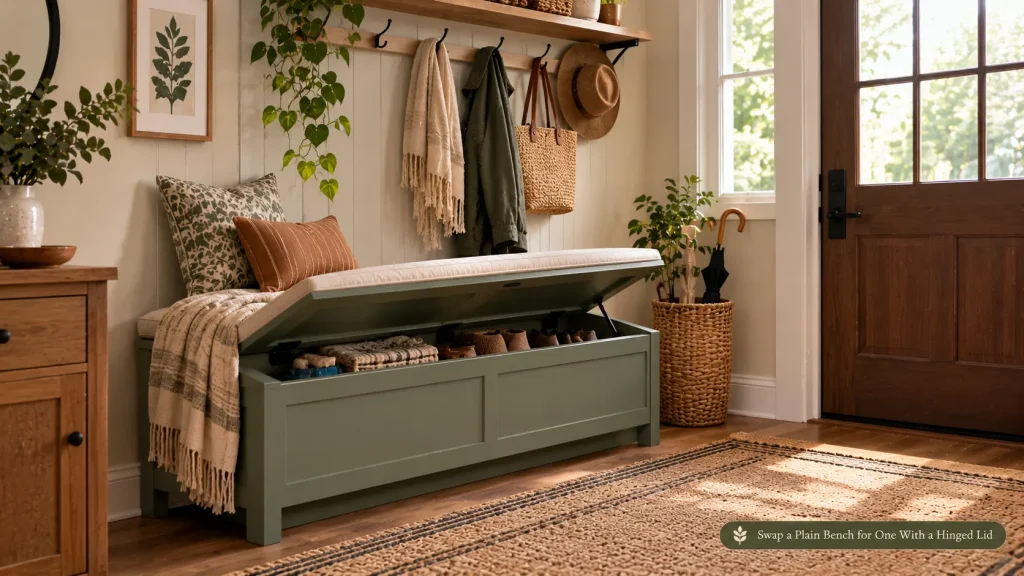
Swap a Plain Bench for One With a Hinged Lid
A bench by the door is handy for putting on shoes. One with a lift-up lid turns that same footprint into a hidden storage box.
It’s a good home for things you use now and then but not daily, like spare gloves, reusable shopping bags, or a dog towel. Let anything damp dry completely before it goes inside, since a closed box can trap moisture and smells.
Look for a lid with soft-close or slow-drop hinges, especially if you have young children, since a heavy lid that slams shut can pinch fingers. A lid that stays open on its own also makes it easier to dig around inside.
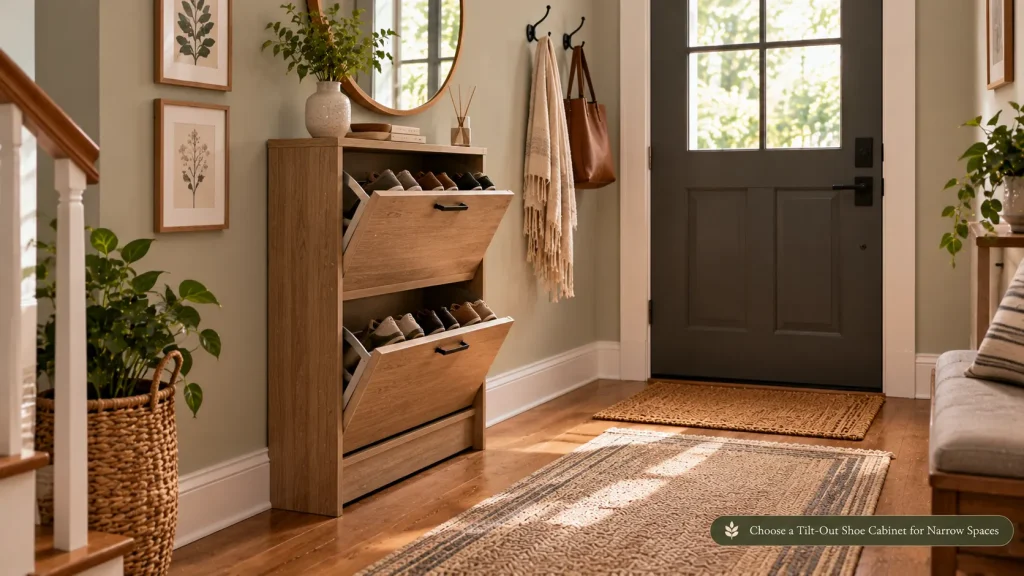
Choose a Tilt-Out Shoe Cabinet for Narrow Spaces
If your entry is more of a corridor than a room, a slim tilt-out cabinet can store several pairs of shoes without taking up much floor space. The fronts swing forward, and shoes sit angled inside.
Some practical points:
- Measure the depth of your longest shoes before buying, since chunky boots may not fit
- Anchor the cabinet to the wall with the anti-tip kit supplied, because a tall, shallow unit can tip when its doors are open
- Leave enough room in front for the doors to open without hitting the front door or blocking the walkway
The flat top doubles as a small shelf, though it’s worth keeping it fairly clear so the cabinet doesn’t become another pile.
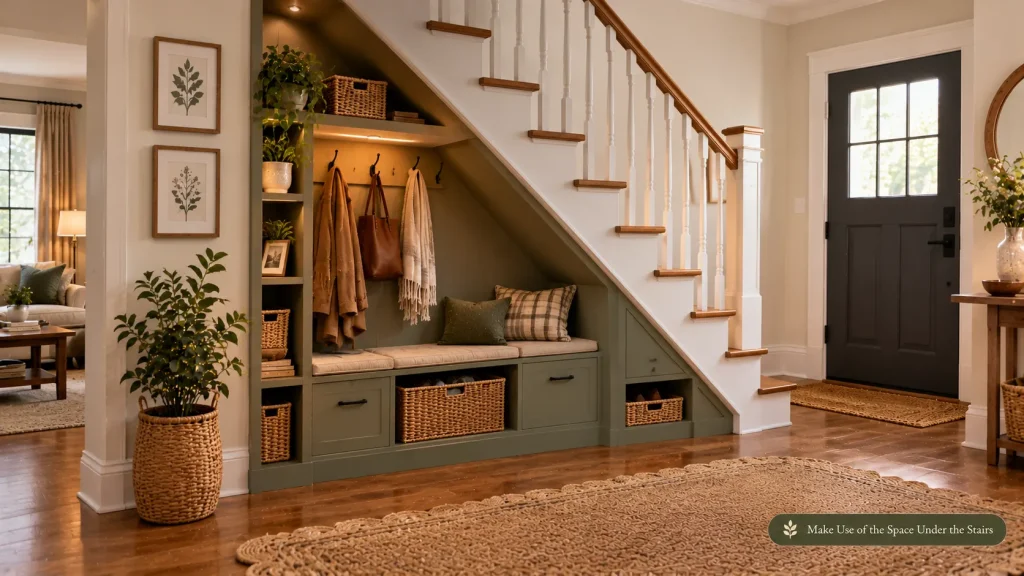
Make Use of the Space Under the Stairs
When the stairs rise right beside the front door, the triangle underneath is often wasted or filled with random boxes.
Pull-out drawers built to follow the slope of the stairs can hold shoes, coats, and even a vacuum cleaner. Even a simpler approach, like a few sturdy labeled bins on low shelves, makes that space easier to use.
Where the stairs begin close to the entrance, deeper storage can often fit under the taller end, while low shelves or bins near the bottom step suit everyday shoes. The exact layout depends on your staircase, so measure before buying anything.
Custom drawers are usually a job for a carpenter, and in some homes the space under the stairs houses pipes, wiring, or a meter that needs to stay accessible. Check what’s in there first, and keep access to anything that needs servicing.
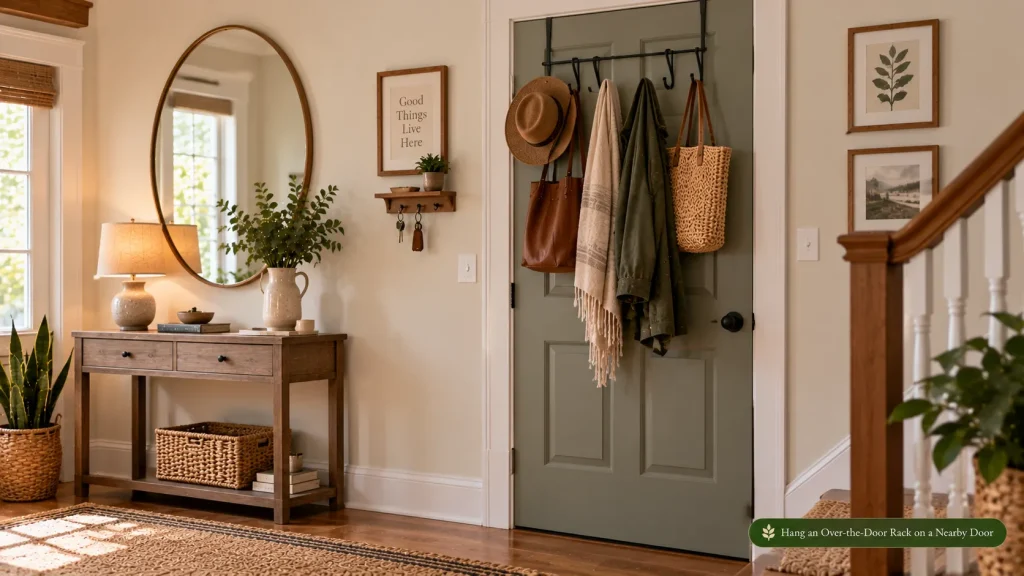
Hang an Over-the-Door Rack on a Nearby Door
Front doors are often too thick for over-the-door hooks, and anything hanging there can get in the way of the lock or seal. But a coat closet door, a hallway door, or a utility room door just off the entry often works well.
An over-the-door rack with pockets can hold:
- Hats, gloves, and scarves
- Sunscreen and bug spray for summer
- Dog leashes and waste bags
- Small umbrellas
Choose clear pockets if you want to spot small items quickly, or label each pocket by category. In a home with a dog, for instance, one row might hold the leash, treats, and waste bags, so the whole walk kit is ready in one spot. Check that the door still closes properly once the rack is in place.
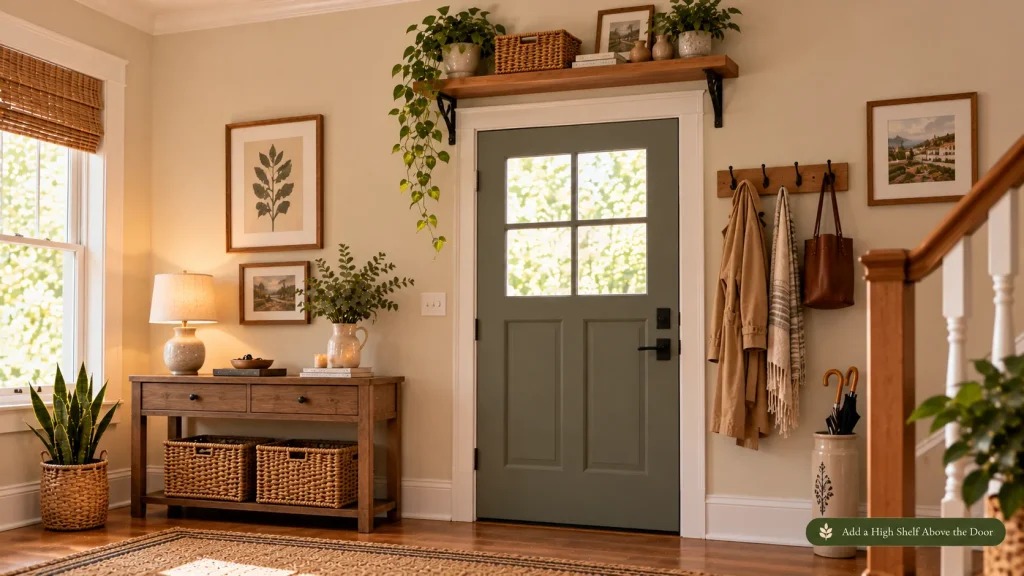
Add a High Shelf Above the Door
The space above a doorway is easy to forget. A single sturdy shelf mounted above the front door or an interior doorway nearby can hold things you don’t need every day.
Think spare light bulbs, a box of seasonal accessories, or a basket of picnic blankets.
Mount the shelf into studs or with fixings rated for the load, and keep it well above head height. Stick to light, soft items, and keep anything heavy or breakable off it, especially above a door people use all day. Lidded boxes help keep dust out.
Because the shelf is a little awkward to reach, save it for things you only need occasionally rather than everyday essentials.
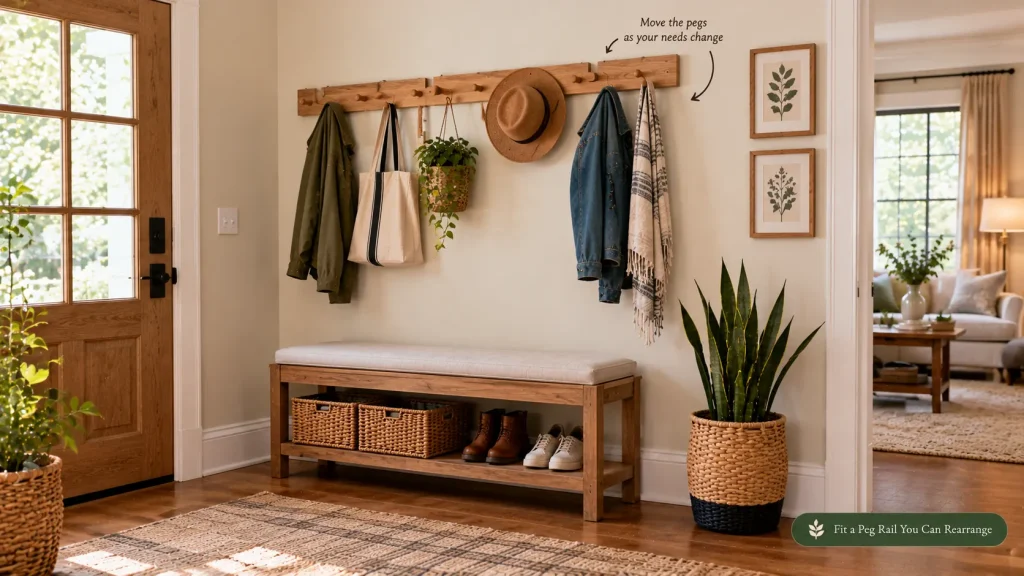
Fit a Peg Rail You Can Rearrange
A Shaker-style peg rail is a wooden strip with evenly spaced pegs. It’s simple, but its strength is flexibility.
Hang a tote bag on one peg in the morning and a wet raincoat on it in the evening. If you want adjustable spacing, look for a rail designed with removable or repositionable pegs, so you can change the layout as the household changes.
For example, a family with toddlers might start with a rail low on the wall for small backpacks and later move it up as everyone grows. A long rail along one entry wall can also hold a small hanging shelf or mirror, if your model allows it.
As with any wall storage, fix the rail securely into studs or with the right anchors for your wall type.
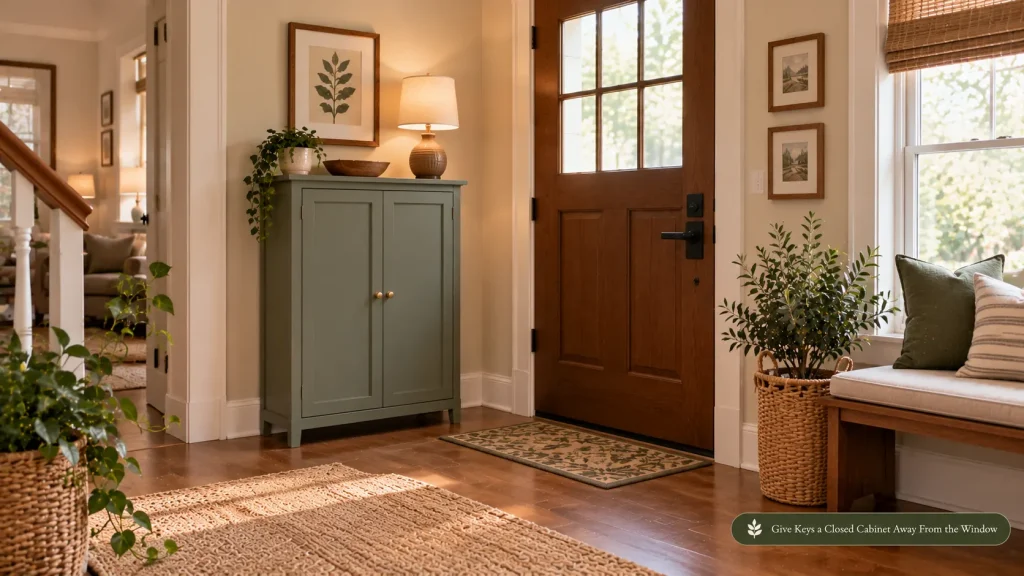
Give Keys a Closed Cabinet Away From the Window
Many people hang keys on hooks right by the front door. It’s convenient, but keys hanging in plain view from a window or glass door panel can catch the attention of the wrong person.
A small wall-mounted key cabinet with a door keeps keys organized and less visible from outside. It’s an organizing tool rather than a security device, so placement matters most. Put it a little way into the hall, away from windows, glass panels, and the letterbox.
Many cabinets also have room for spare keys, labeled clearly for the shed, the car, or a neighbor’s house.
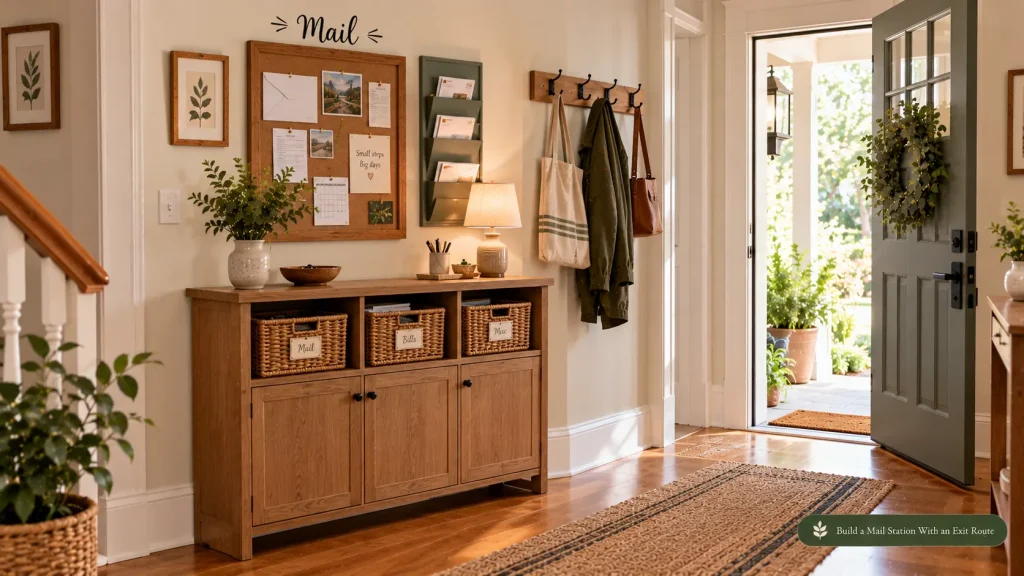
Build a Mail Station With an Exit Route
Paper is one of the trickiest things to keep under control near the door, because new mail arrives almost daily.
A wall-mounted mail sorter with separate slots for incoming, outgoing, and “to deal with” helps, but the real difference comes from what sits next to it. A small recycling bin or paper basket right below the sorter means junk mail and flyers can go straight in before they reach the counter.
Picture a slim three-slot sorter on the wall, a pen clipped to the side, and a narrow bin underneath. Bills go in one slot, letters to post in another, and everything else gets tossed on the spot. Sorting mail the moment it arrives becomes much easier, so less of it ends up stacked on a counter.
A shredder nearby can help with personal documents, though many people prefer to keep that in an office or cupboard.
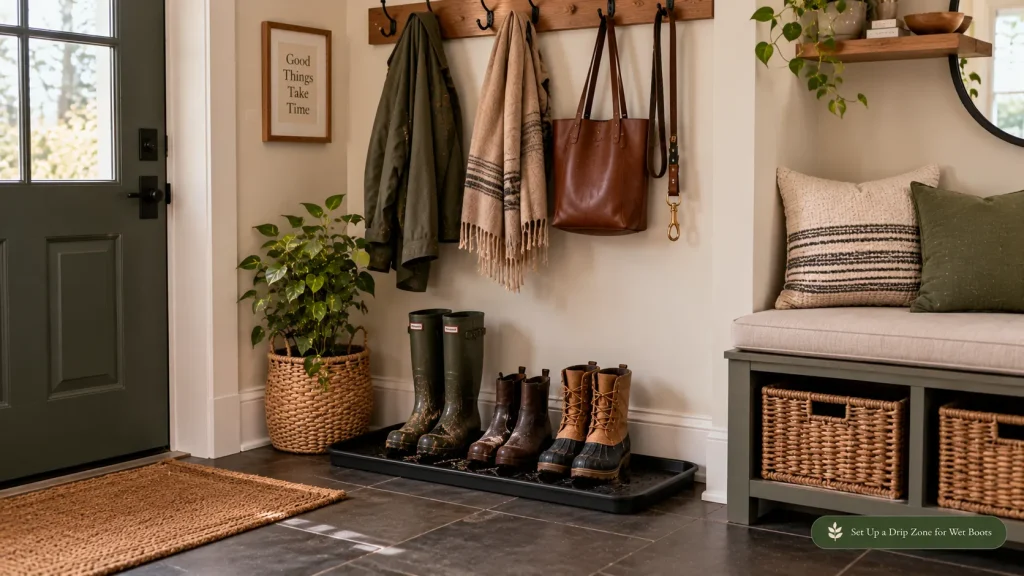
Set Up a Drip Zone for Wet Boots
Wet shoes and boots shouldn’t go straight into a closed cabinet, where they stay damp and can start to smell or grow mold.
A rubber or plastic boot tray with raised edges catches drips and mud, keeping the floor underneath safe. If you’d like footwear off the floor while it dries, add a suitable boot rack, and follow the care instructions for leather or other delicate materials. Good airflow matters more than anything, so keep the drying spot ventilated.
In rainy climates or homes with outdoor pets, a tray just inside the door can protect wooden or laminate floors from water damage. Empty and rinse it regularly. Once boots are dry, they can move into the main shoe storage.
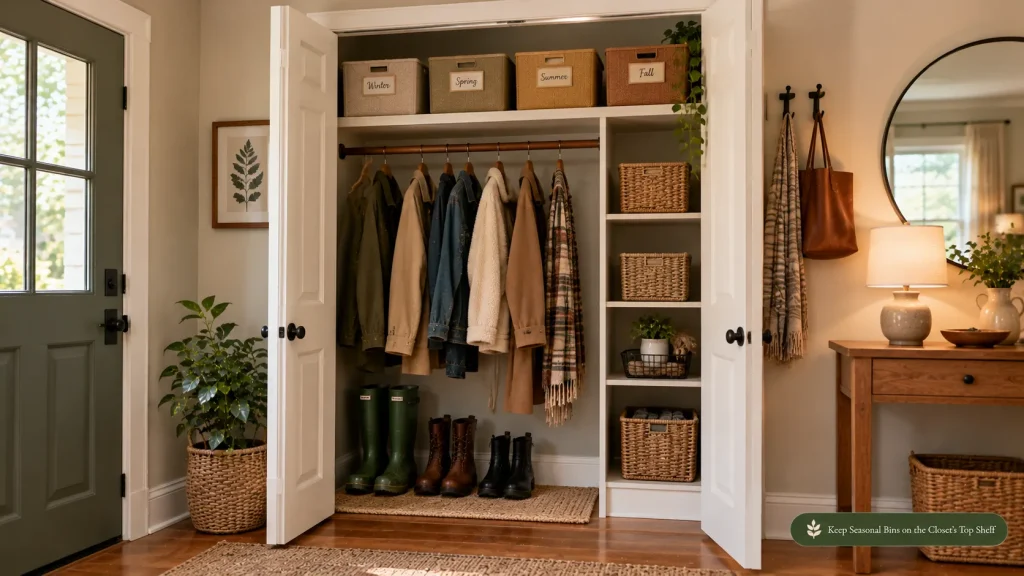
Keep Seasonal Bins on the Closet’s Top Shelf
Hats, gloves, and scarves take up a lot of space for something you only need part of the year.
Instead of keeping everything out all year, sort accessories into clear, labeled bins by season and store them on the top shelf of a coat closet. When the weather changes, swap one bin down and the other up. Keep year-round essentials, like sunscreen in sunny climates, somewhere easier to reach.
This works for:
- Winter hats, gloves, and scarves
- Sun hats and lightweight scarves you mainly use in warmer months
- Rain gear like spare ponchos or rain boots for kids
It’s one of the more low-cost entryway storage ideas, and it frees up a surprising amount of everyday space.
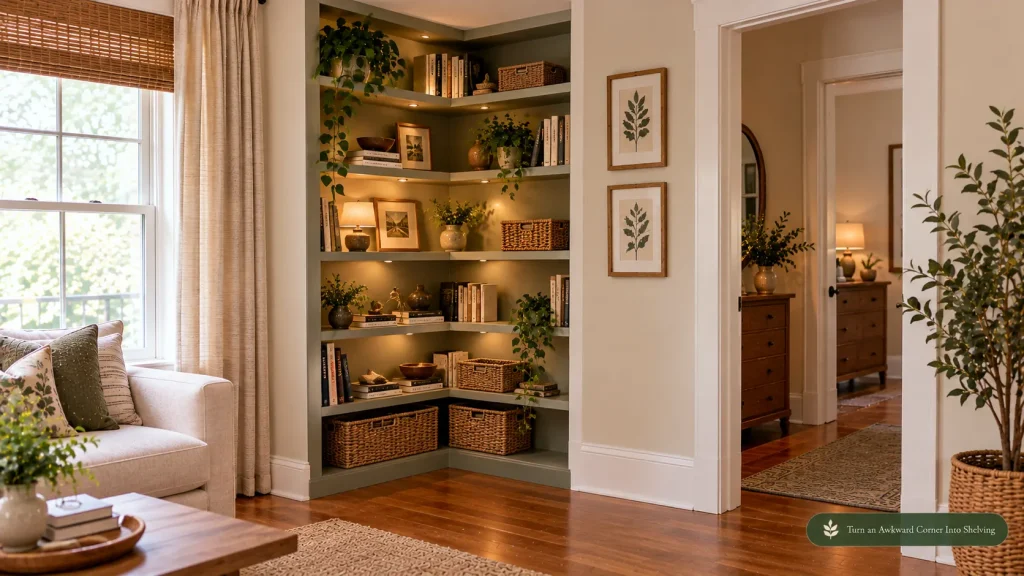
Turn an Awkward Corner Into Shelving
Many entries have a corner that’s too small for furniture but annoying to leave empty. A corner shelving unit, either freestanding or wall-mounted, can make it useful.
Open shelves suit decorative baskets or a plant, while a closed corner cabinet hides less attractive things like spare cleaning cloths or a lint roller.
A mix of both often works well. Lower cupboards can hide household supplies, while the open shelves above hold a basket or a small decorative piece.
For tall freestanding units, use an anti-tip kit, particularly in homes with children or pets. Also make sure the shelves don’t stick out into the walkway or catch on the door as it opens.
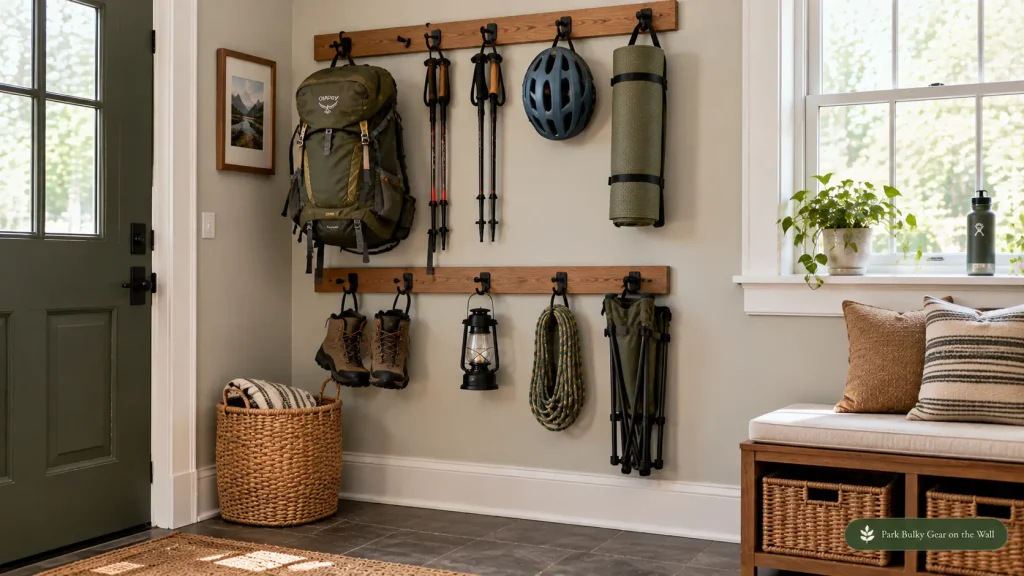
Park Bulky Gear on the Wall
Strollers, scooters, and bikes often end up leaning on the wall or blocking part of the hall.
Wall-mounted holders can lift some of this gear off the floor. Choose a holder made for the specific item and rated for its weight and shape, such as a scooter bracket. For a stroller, check the manufacturer’s storage guidance first, and only wall-mount it if it can be lifted and secured safely. Otherwise, a folded stroller standing in a closet or corner is fine.
Heavier items, like adult bikes, need brackets rated for the weight and fixed into studs or masonry. If that’s not possible, a freestanding bike stand is an alternative.
In apartment buildings, check the rules about storing items in shared hallways. Many buildings don’t allow anything in common areas, since it could block an escape route in an emergency.
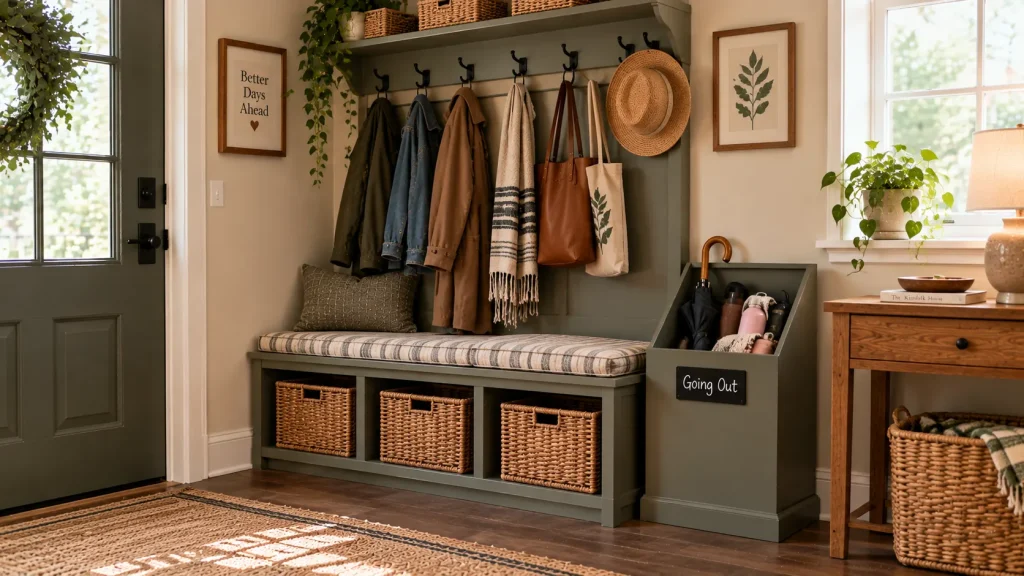
Add a “Going Out” Bin
Library books, a dish to return to a neighbor, a parcel to post. These things often sit by the door for days because there’s no specific spot for them.
A small bin or basket labeled “going out” gives them a home. Place it right where you’ll see it on the way out, perhaps on the bench or a low shelf near the door.
Keep the bin small so it can’t turn into long-term storage, and empty it whenever someone heads out with something in it.
If You Only Have a Few Feet
Not every entry has room for all of this. Here’s a quick way to narrow things down by space:
Just a strip of wall: a peg rail, a mail sorter, and a wall-mounted key cabinet
A narrow hallway: a tilt-out shoe cabinet and an over-the-door rack on a nearby door
A door that opens straight into the living room: a compact bench or a narrow wall-mounted shelf, as long as it doesn’t block the door swing or walkway
A closet but no other space: seasonal bins up top and a boot tray below
Mistakes That Bring the Pile Back
Storage that’s harder to use than the floor. If putting something away takes more effort than dropping it, the floor wins. Open, easy-to-reach storage usually works better for everyday items.
Storage children can’t reach. Kids are more likely to put away shoes and bags when at least some hooks, baskets, or shelves sit at their height.
Blocking the door’s swing or the escape route. Every piece of storage near the door should leave the walkway clear and the door able to open fully.
Filling every bin and shelf. Leaving a little spare room means new things have a place to go, instead of starting a fresh pile.
Questions About Entryway Storage
What are the best entryway storage ideas for small spaces?
Wall storage, like peg rails, hooks, and slim mail sorters, uses very little floor space. A tilt-out shoe cabinet and over-the-door racks on nearby doors are also good options.
How do I store shoes without a closet?
For dry footwear, a tilt-out cabinet, storage bench, or open shoe rack can all work. Leave wet shoes on a drip tray in a ventilated spot until they’re completely dry, then put them away.
Can renters add entryway storage?
Yes. Freestanding benches, shoe cabinets, and corner shelves need no drilling, though tall units should still be anchored. Ask your landlord before drilling into walls or adding permanent fixings, and check your lease for restrictions.
How do I keep the entryway from getting cluttered again?
Pick a regular moment, such as one evening a week, to clear the mail, move dry boots to storage, and empty the “going out” bin. A quick routine usually keeps things manageable.
What should I not store in the entryway?
Valuable items in view of windows, important papers that could get mixed up with junk mail, and anything that blocks the door or walkway. Fragile or heavy items are also better kept away from high shelves.
Clear the Floor, One Group at a Time
You don’t need all 13 of these ideas, and you certainly don’t need to try them all this weekend. Look at what’s piling up by your door and pick the group that’s biggest. Fix that first, live with it for a week or two, and then move on to the next.
Once that first group has a convenient place to go, keeping the entrance clear takes much less effort, and the rest of these entryway storage ideas can follow when you’re ready.