

Wardrobe Ideas for Every Bedroom: 10 Ways to Store Smarter, Inside and Out
Picture a wardrobe that’s been running on autopilot for a few years.
A rail packed so tightly that pulling out one shirt drags three others with it. A high shelf piled with sweaters that topple whenever someone tugs at the bottom one. Shoes heaped on the floor. And somewhere at the back, a dress that hasn’t been seen in two years because nobody remembers it’s there.
Sometimes a wardrobe genuinely is too small. Often, though, the bigger issue is how the space inside is arranged. A single rail and one shelf suit some wardrobes and some people, but not everyone’s mix of clothes.
The 10 wardrobe ideas below cover the inside, the doors and exterior, and the awkward spaces where a standard wardrobe won’t fit. Some are quick swaps you can make this weekend. Others are worth planning if you’re buying or building a new wardrobe.
Check What You Need to Store First
Before measuring the wardrobe, take a look at what’s going into it. That tells you what kind of space you actually need.
Sort your clothes into rough groups. With a small wardrobe you can pull everything out at once. With a larger one, working one section at a time is more manageable.
- Long hanging: dresses, long coats, maxi skirts
- Short hanging: shirts, blouses, jackets, folded trousers on hangers
- Folded: sweaters, T-shirts, jeans, gym clothes
- Small items: scarves, belts, bags, accessories
- Shoes: everyday pairs and occasional ones
Now look at the piles. If the short-hanging pile is enormous and the long pile is small, a wardrobe with one tall rail is wasting a lot of space below your shirts. If folded clothes outnumber everything, you need more shelves or drawers, not more rail.
This is also the moment to set aside anything you no longer wear. Every piece that leaves the wardrobe frees up room, and makes the wardrobe ideas below easier to put into practice.
Inside the Wardrobe
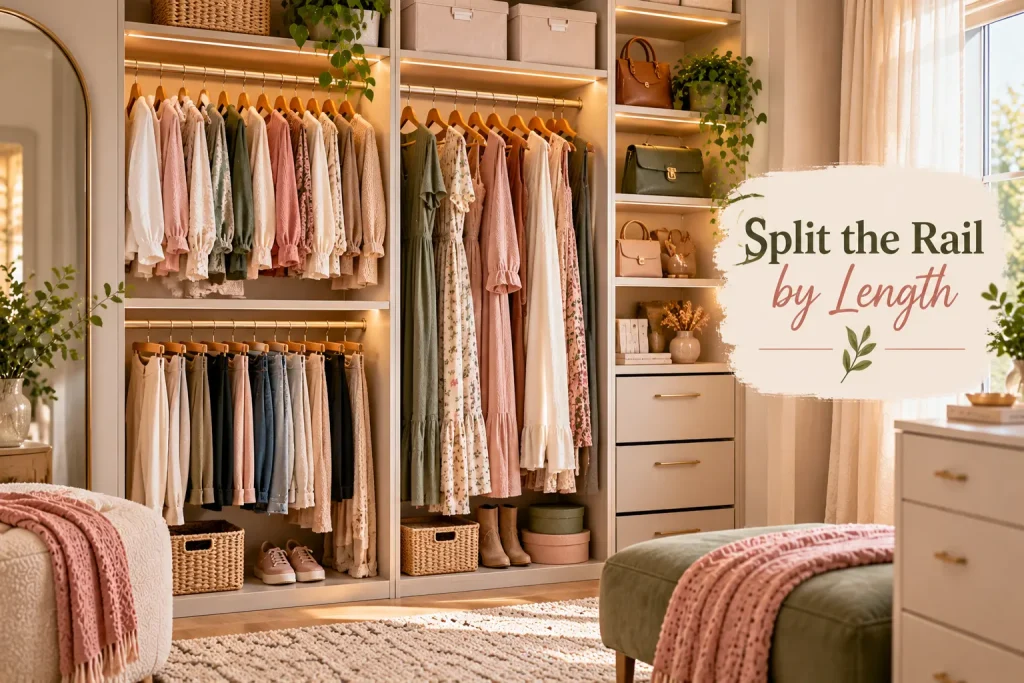
Split the Rail by Length
If most of what you hang is short, the space below those clothes may be sitting empty. Depending on your garments and the wardrobe’s height, there may be room for a second row. Adding a second rail lower down, or using a hanging rod extender that hooks onto the main rail, creates two rows of short hanging in the same width.
Keep one section full height for longer pieces. In a typical two-door wardrobe, that might look like this:
- One side with a double rail for shirts, blouses, and jackets
- The other side with a single high rail for dresses and coats, and a shoe shelf below them
Before adding a lower rail, measure your longest short garment on its hanger, so it clears the rail below. Hanging extenders are easy to remove, which suits renters, but they add weight to the original rail and its supports. Check the load limits of both the extender and the existing rail, since a full row of jackets is heavier than it looks.
Swap Loose Shelves for Drawers and Baskets
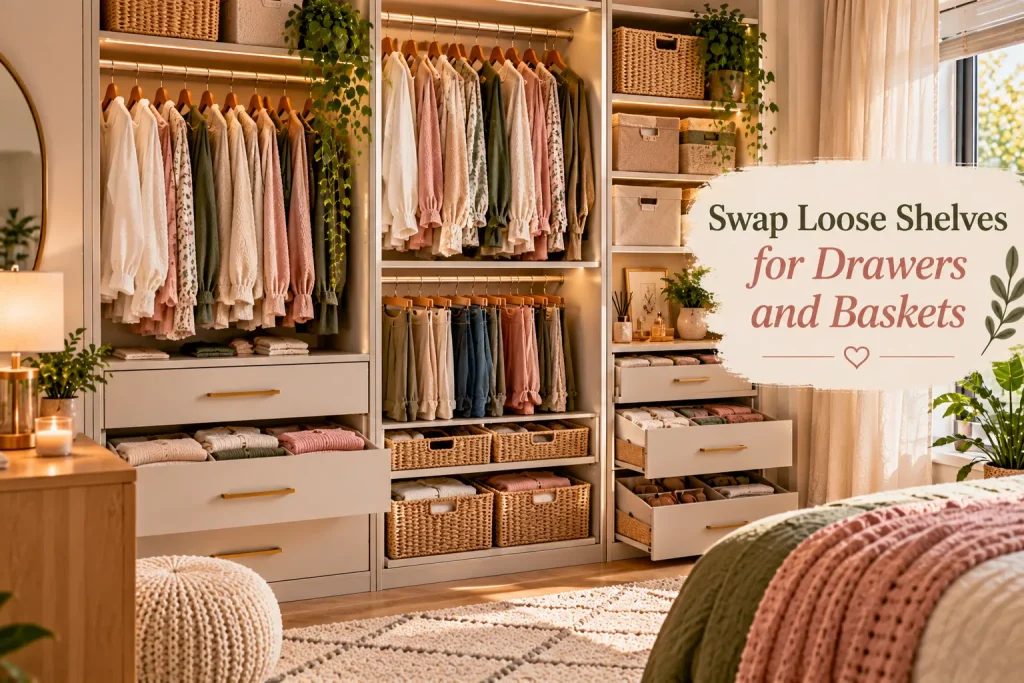
Deep wardrobe shelves look roomy, but folded clothes tend to collapse into each other, and things at the back get forgotten.
Pull-out drawers or sliding baskets can help. Because they come toward you, items at the back become much easier to reach and see.
If built-in drawers aren’t an option, sturdy fabric boxes or lidded bins on the existing shelves work as a cheaper alternative. Labels on the front help with high shelves.
For folded items that do stay on shelves, shelf dividers keep stacks upright and stop sweaters from sliding into the next pile.
Inside drawers, folding T-shirts and gym clothes so they stand upright in rows, rather than stacking them flat, lets you see more of them at a glance. It works well for lighter everyday pieces, though bulky sweaters and delicate items are usually better laid flat.
Bring the High Rail Down to You
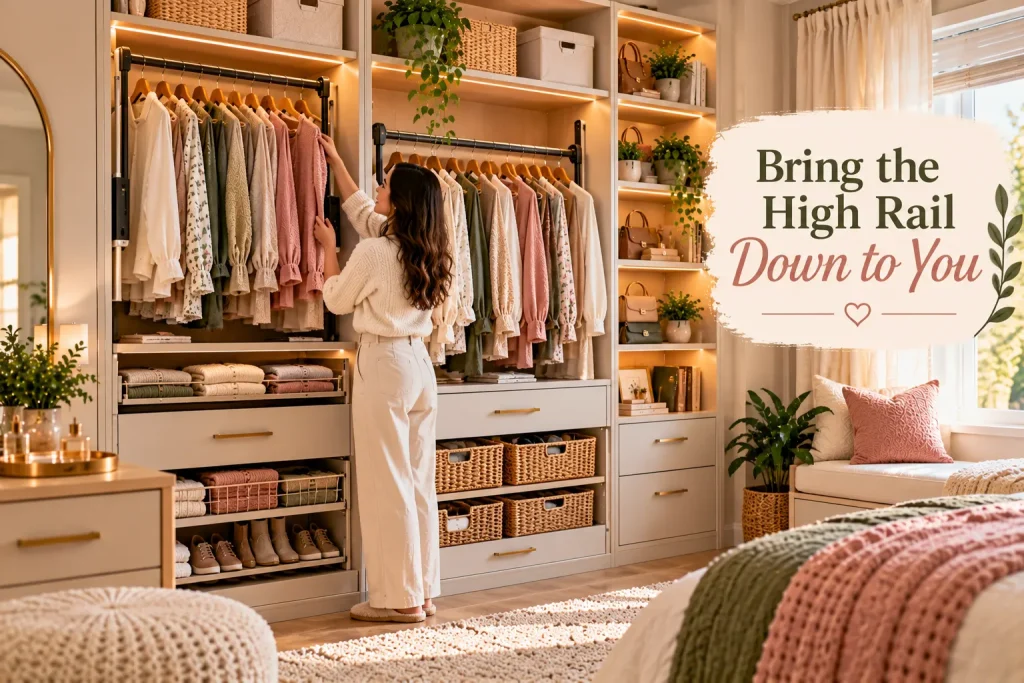
Tall wardrobes often have a rail near the ceiling that’s hard to reach without a step stool. A pull-down wardrobe rail, sometimes called a wardrobe lift, solves this. You pull a handle and the whole rail swings down and forward, then pushes back up when you’re done.
These lifts are useful for off-season clothes or for anyone who finds it awkward to reach high. They need to be installed to the manufacturer’s instructions and chosen for the weight they’ll carry, and the wardrobe sides need to be sturdy enough to hold the fittings. Check that there’s enough clearance for the rail to swing down without hitting the doors, shelves, or anything nearby. For a built-in or custom wardrobe, it’s worth discussing with the installer.
If a lift isn’t practical, keep the highest rail for things you rarely need and store a sturdy step stool nearby. Choose one with stable, non-slip feet and a wide top, tall enough for the height you need, and use it on a level floor. It’s much safer than a chair, and easier if you take down a few hangers at a time rather than an armful.
Light the Inside
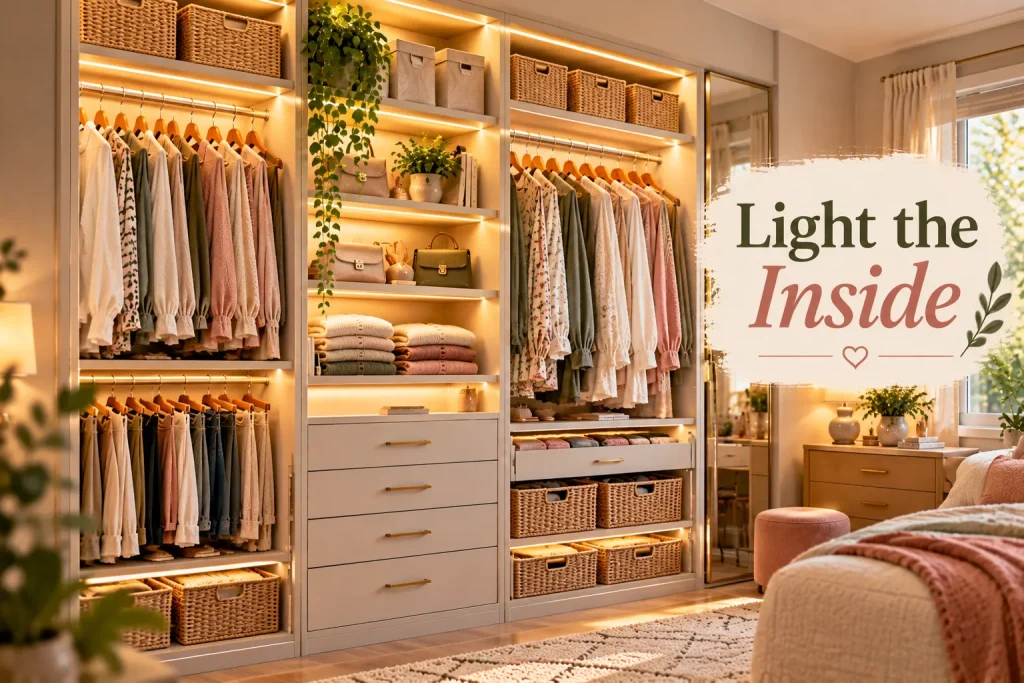
Wardrobes can be surprisingly dark, especially in the evening or if they sit in a corner away from the window. Navy and black clothes can be hard to tell apart.
Battery-powered or rechargeable LED strips and puck lights with motion sensors are a simple fix. They switch on when the door opens and off again when it closes. They attach in different ways depending on the product, and need no wiring.
Rechargeable versions save buying batteries. Charge and use them according to the manufacturer’s instructions. Place lights toward the front of the wardrobe rather than the back, so the light falls on the clothes instead of behind them. A neutral-white LED with good color rendering, often listed as a high CRI, can make it easier to tell similar colors apart.
Hardwired wardrobe lighting can look neater in a built-in wardrobe, but that should be done by a qualified electrician.
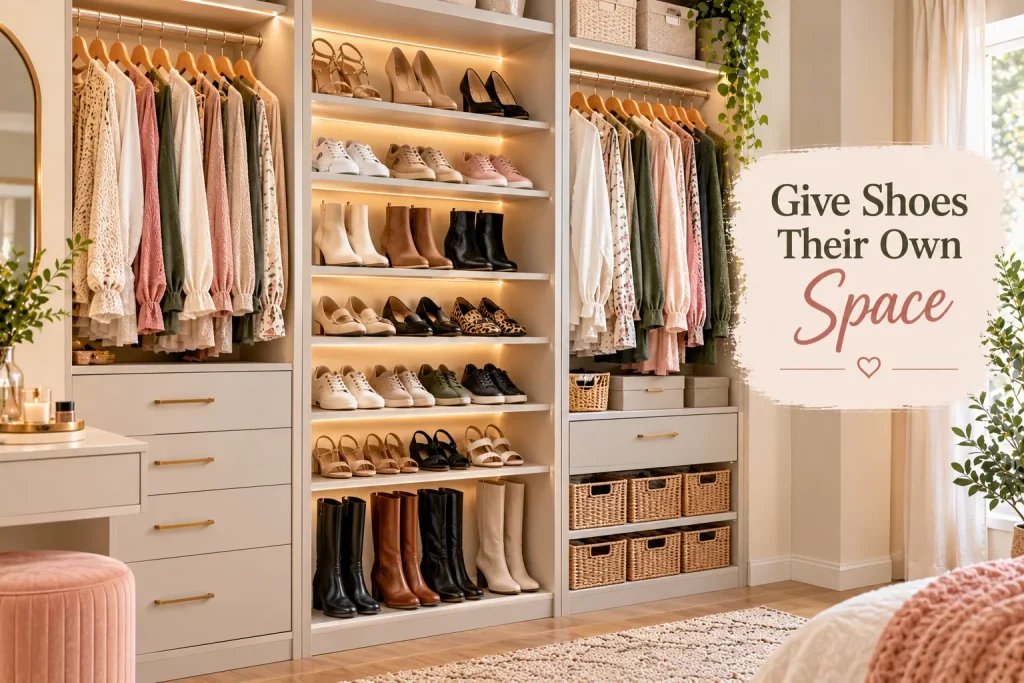
Give Shoes Their Own Space
Shoes piled on the wardrobe floor get scuffed and are hard to see. A dedicated spot for them keeps the base tidy.
Low shoe racks fit easily under a row of short hanging clothes. Angled pull-out shelves show each pair clearly and work well in built-in wardrobes. Keep everyday shoes at the front or closest to the door, and occasional ones further back or higher up.
Clear shoe boxes suit shoes you wear less often, since you can stack them and still see what’s inside. Make sure shoes are clean and completely dry before they go into a closed box, and let everyday pairs air out after rain or a long day, since damp shoes in an enclosed space can leave things smelling musty.
Use the Inside of the Doors
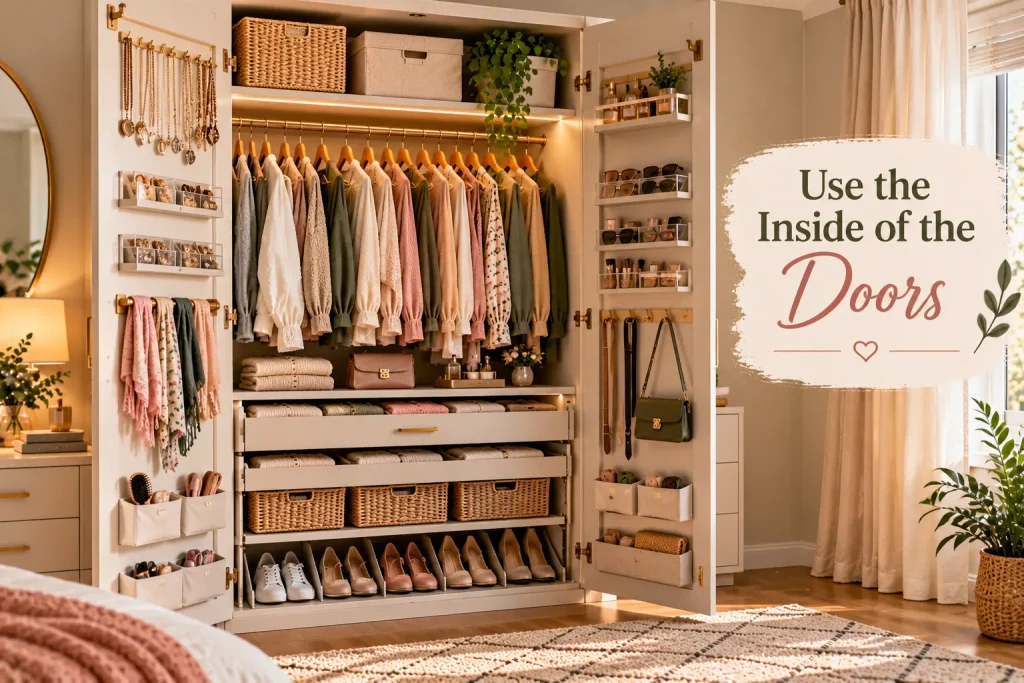
The inside of a hinged wardrobe door is often bare. Small hooks, a slim rail, or a hanging organizer there can hold belts, scarves, necklaces, or tomorrow’s outfit.
Keep it light, since door hinges aren’t designed to carry heavy loads, and check that anything you add doesn’t stop the door from closing or catch on the clothes inside. Shallow items work best.
For example, a few small hooks on one door could hold a light scarf, a belt, and a necklace you plan to wear tomorrow. Heavier items like full handbags are better on a sturdy wall hook or shelf.
On the Outside
Choose Mirrored Doors
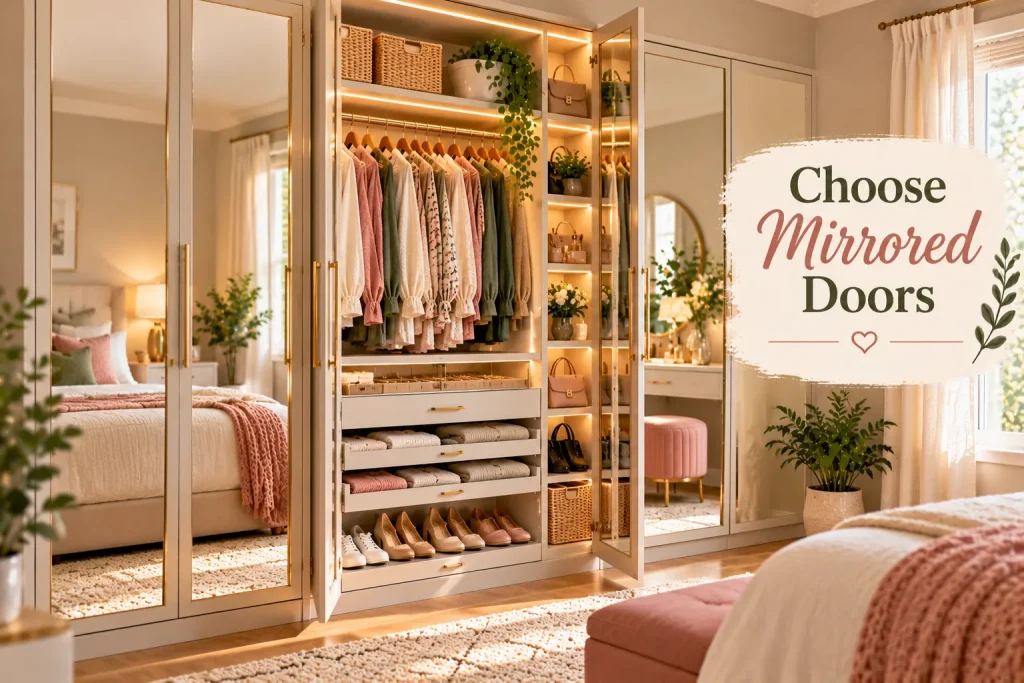
A full-length mirror can be useful in a bedroom, and putting it on the wardrobe door means it doesn’t take up wall or floor space.
Mirrored sliding doors are common in fitted wardrobes, and some freestanding wardrobes come with a mirrored door panel. Mirrors also bounce light around, which can help a smaller or darker bedroom look more open.
Think about what the mirror will reflect from the bed, though. Some people find a large mirror facing the bed distracting at night, and a mirrored door opposite a window can create glare in the morning. A mirror on the inside of a door is a quieter alternative.
If you’re adding a mirror to an existing wardrobe door, choose one designed for door mounting and follow the fixing instructions, since glass is heavy and the extra weight can strain hinges. Sliding doors need mirror panels compatible with their track and hardware. For large mirrors, professional fitting is often the safer choice. Safety-backed or shatter-resistant mirror glass is worth looking for, especially in children’s rooms.
Refresh an Old Wardrobe’s Exterior
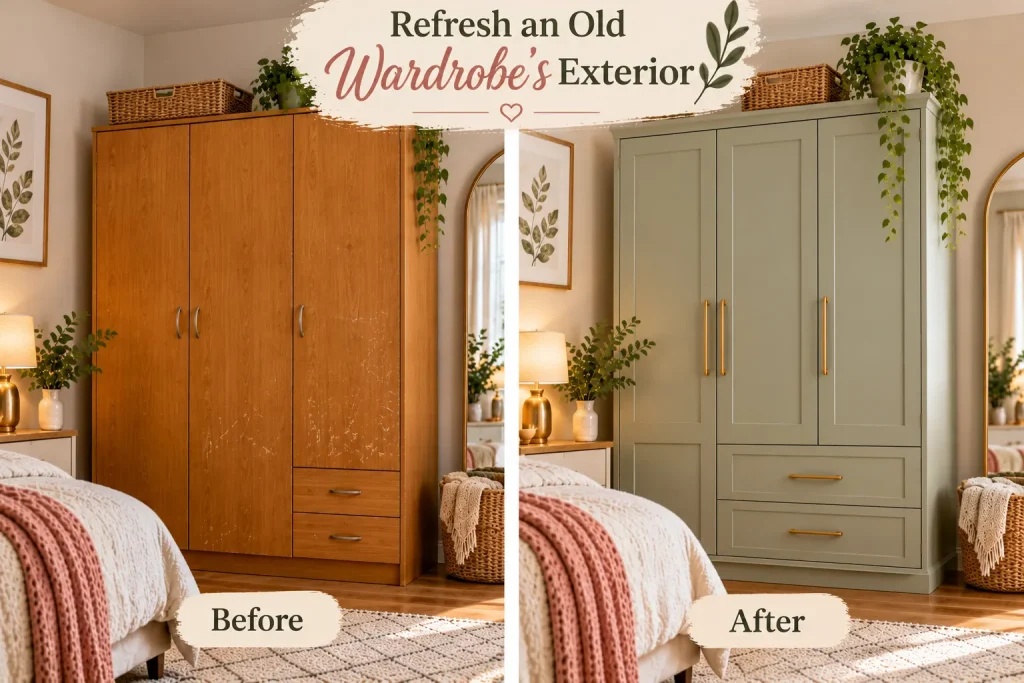
A solid but dated wardrobe doesn’t always need replacing, and keeping a sturdy piece often gives you more storage for your money than a cheaper new one.
Painting is the most common update. Good results depend on preparing the surface properly for its material, whether that’s wood, veneer, or laminate, and using a primer and paint suited to it. A test patch on the back or inside of a door is a sensible first step.
Handles are worth a look too. If the current ones are small or awkward to hold, switching to a shape that suits your grip makes opening doors and drawers easier, and it updates the look at the same time. Adding thin trim to plain doors to create a paneled look is another option. If the wardrobe is antique or particularly valuable, it may be worth getting advice before painting, since that can affect its value.
When Space Is the Problem
Fit a Wardrobe Into an Awkward Space
Alcoves beside a chimney breast, the space under a sloping ceiling, or a wide spot at the end of a hallway can all hold a wardrobe if it’s made to fit. In a hallway, make sure there’s still a clear walkway and that doors, including the wardrobe’s own, can open fully.
Built-in or custom wardrobes make the most of these spaces, though they cost more than freestanding pieces. A simpler route for an alcove is a rail fixed between the two side walls, using rail sockets or brackets rated for the load and fixings suited to the wall type, with shelves above and baskets below, finished with doors or a curtain.
For example, an alcove beside a chimney breast might hold a full-width rail at the top for hanging, a shelf above it for boxes, and a low chest of drawers or baskets underneath. A pair of simple doors or a curtain across the front pulls it together.
Under a sloping ceiling, keep the tall rail at the high end and use the lower part for drawers, shoe storage, or folded clothes. Measure the slope carefully at several points, since sloped ceilings are rarely perfectly even.
In a rental, it’s worth checking with your landlord before fixing anything to the walls.

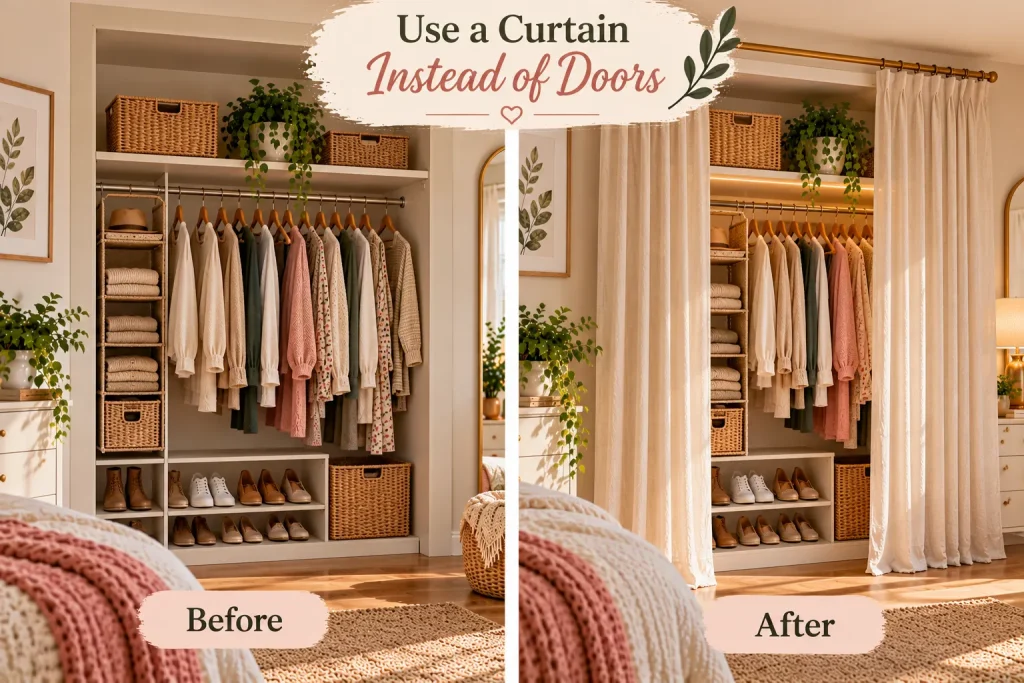
Use a Curtain Instead of Doors
In tight bedrooms, wardrobe doors can be the problem. Hinged doors need space to swing open, and there may not be room for them.
An open wardrobe frame or clothing rail with a curtain in front avoids that entirely. A ceiling-mounted track, fitted with fixings suited to the ceiling, or a tension rod rated for the curtain’s weight across an alcove holds the curtain, which slides aside when you need to get dressed.
Choose a fabric that’s easy to wash and heavy enough to hang neatly.
A curtain doesn’t enclose clothes as fully as a closed door, so it tends to suit clothes you wear regularly better than long-term storage.
Make Room With a Seasonal Swap
This isn’t one of the ten, but it’s a habit that makes all of them work better, and it costs nothing. Twice a year, move clothes you won’t wear for the next few months, like heavy coats in summer or linen in winter, into storage boxes or under-bed bins.
That leaves the main rail and the easy-to-reach shelves for what you actually wear right now.
Make sure clothes are clean and fully dry before storing them. Vacuum bags save space for bulky everyday items like duvets or puffer jackets, but long compression can affect structured, tailored, or delicate pieces, which are better kept in breathable fabric bags or boxes.
Common Wardrobe Mistakes
Pushing the wardrobe tight against a cold wall. On outside walls especially, a wardrobe with no gap behind it can trap damp air. A small gap helps air move.
Using the wrong hanger for the garment. Thin wire hangers can leave marks on knitwear and let heavy coats sag. Slim hangers save space for everyday tops, but coats, tailored pieces, and trousers may need sturdier or specialist ones.
Forgetting to anchor tall wardrobes. Freestanding wardrobes can tip, especially when doors are open or drawers are pulled out. Secure them to the wall with an anti-tip kit, following the manufacturer’s instructions.
Questions About Wardrobe Ideas
Should I choose shelves or drawers inside a wardrobe?
It depends on what you store. Shelves are quick to use and suit bulky folded items like sweaters. Drawers work better for small or soft things that slide around, such as T-shirts, underwear, and gym clothes. Many people find a mix of both works best.
Is a built-in wardrobe better than a freestanding one?
Each has advantages. Built-in wardrobes can fit awkward spaces and use the full height of a room, but they cost more and stay with the house. Freestanding wardrobes are more flexible and can move with you.
How can I keep clothes fresh in a wardrobe?
Avoid packing it too tightly so air can circulate, and make sure clothes are completely dry before putting them away. Persistent musty smells may point to a moisture problem in the room, which is worth investigating rather than masking.
How much hanging space do I need?
It depends entirely on your clothes. Counting how many items you hang in each length, then hanging them loosely on one rail to measure, gives a realistic figure. Adding a little extra width allows room for new pieces.
How deep should a wardrobe be?
A wardrobe needs enough depth for clothes on hangers to hang without being squashed against the doors, which usually means somewhere around 55 to 60 cm (about 22 to 24 inches) for a standard hanging rail. Shallower wardrobes can work with a pull-out or front-facing rail, so check the internal depth before buying.
Start With the Shelf You Avoid
Most wardrobes have a spot that gets avoided: the shelf that’s too high, the dark back corner, the pile on the floor. That spot is usually the best place to begin, because it’s where space is being lost.
You don’t need to try all of these wardrobe ideas. Fix the part you avoid first, then live with it for a few weeks before deciding what to change next.