
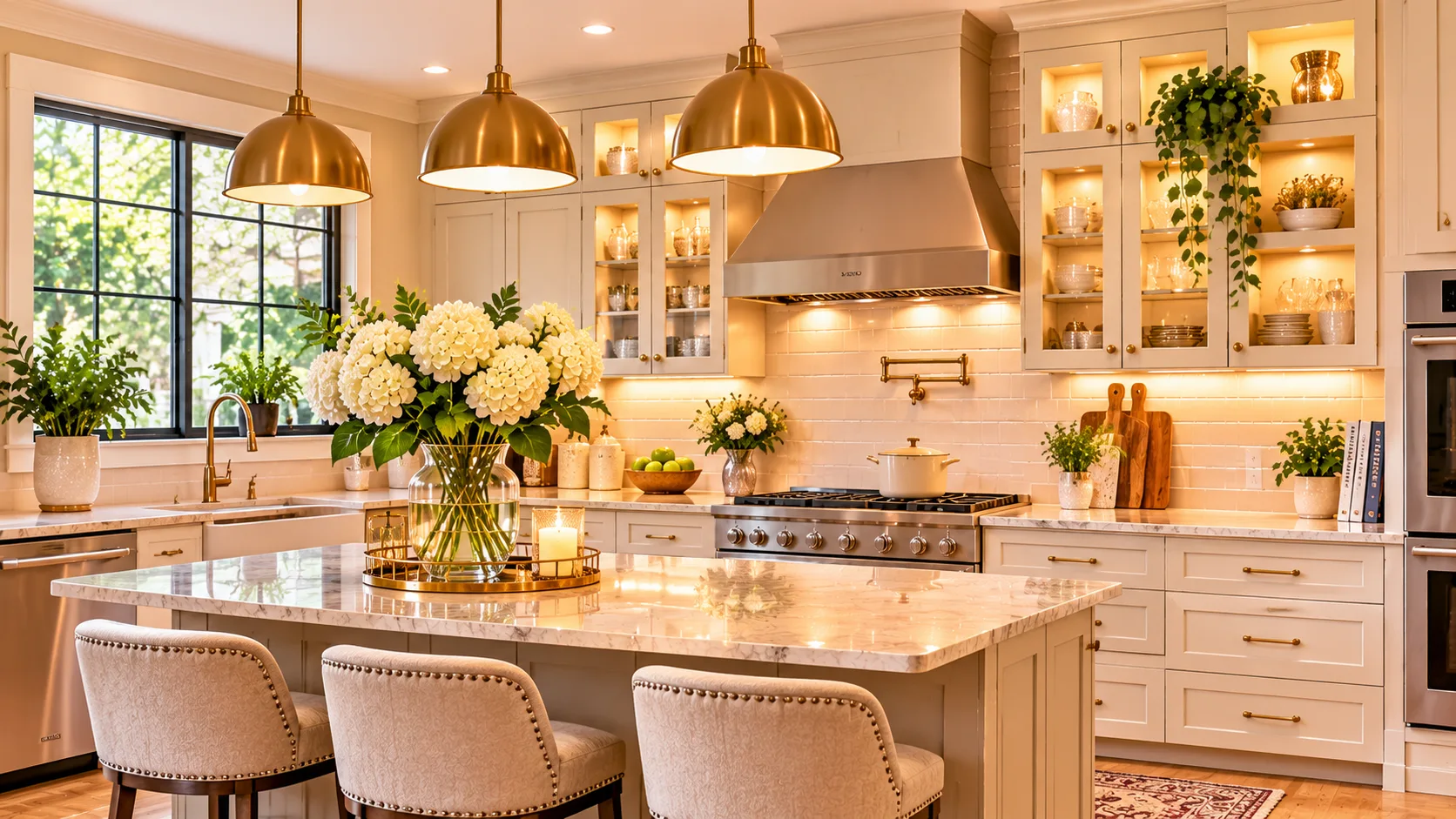
Bright Where It Counts: 9 Kitchen Lighting Ideas for Cooking, Gathering, and Late-Night Snacks
Try this tonight. Turn on your main kitchen light, stand at the counter where you chop vegetables, and look down.
Is your cutting board in shadow? Is the light glaring off a shiny countertop? Does the whole room feel a bit like a waiting room?
If any of that sounds familiar, you’re not alone. Lots of kitchens rely on one ceiling fixture in the middle of the room, which means the light lands everywhere except where you need it.
The good news is that better lighting doesn’t always mean a full renovation. Some of the kitchen lighting ideas below need an electrician, but several can be done in an afternoon with plug-in or battery-powered fixtures.
Before You Buy a Single Fixture
A few quick things to know first will save you money and frustration.
Think in layers. Most well-lit kitchens use three types of light:
- Task lighting for chopping, reading recipes, and washing up
- Ambient lighting for general brightness
- Accent lighting for mood, display, and nighttime
Pick a warm color temperature. Bulbs labeled around 2700K to 3000K give a warm, welcoming glow that flatters food and wood. Higher numbers, like 4000K, produce a cooler, whiter appearance, which some people like over work areas. Actual brightness depends on the fixture’s lumen output, not the Kelvin number.
Look for good color accuracy. A CRI (color rendering index) of 90 or higher is a good target if you want food, skin, and cabinet colors to look natural rather than gray or washed out.
Add dimmers wherever you can. Bright for cooking, soft for dinner. A dimmer gives you both from the same fixture, as long as the bulb is labeled dimmable.
Now for the ideas.
Task lighting: light where your hands are (three ideas):
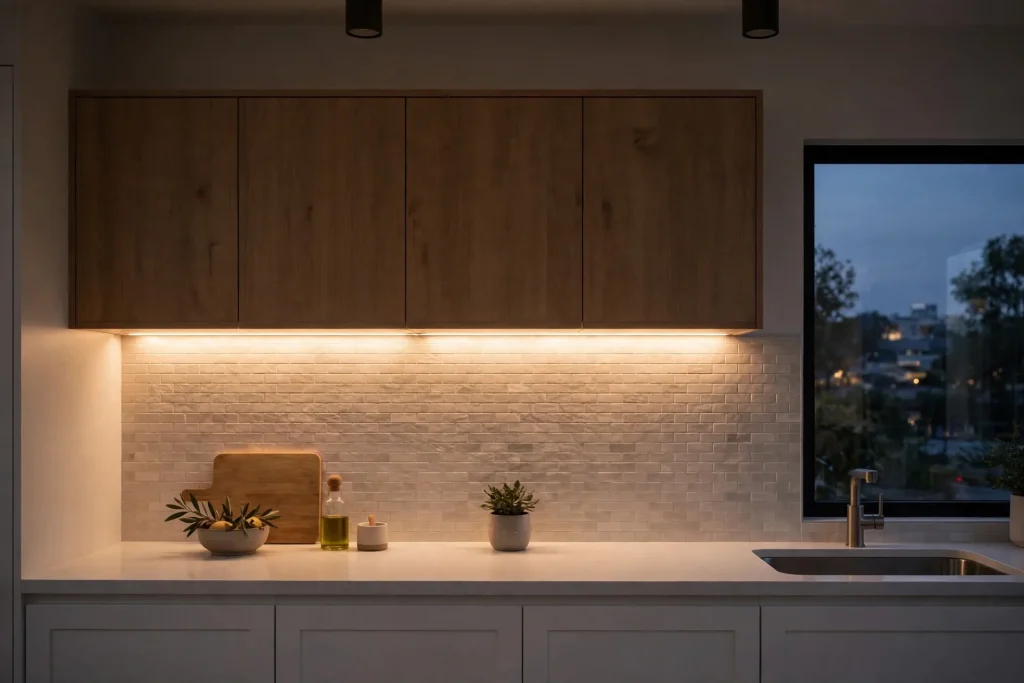
Under-Cabinet LED Strips
If you only make one change, make it this one.
Good kitchen task lighting starts here. Upper cabinets block ceiling light from reaching the counter, so the spot where you actually work sits in shadow. LED strips mounted under the front edge of your cabinets fix that instantly.
Tips for a clean result:
- Mount the strip toward the front of the cabinet, not the back, so light falls evenly across the counter
- Choose an aluminum channel with a diffuser to soften the light and hide the individual dots
- If you notice glare on glossy stone, a frosted diffuser or a slightly angled strip usually helps
Hardwired strips look neatest, but plug-in and rechargeable kits work well for renters. If you choose a hardwired version, have a licensed electrician install it.
Pendants Over the Island
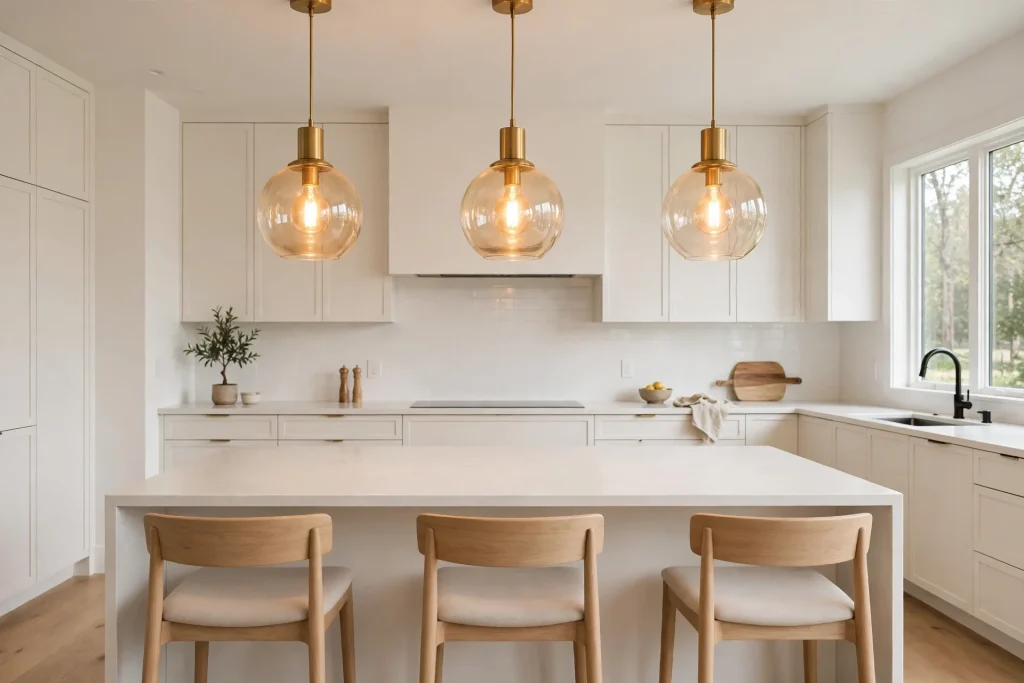
Pendants do two jobs at once. They light up the island for prep work and homework, and they act like jewelry for the kitchen.
The number of pendants depends on the island length. Two usually suits a smaller island, while three works on a longer one. Odd numbers often look balanced, but two can look great too.
Helpful measurements:
- Hang the bottom of the pendants about 30 to 36 inches (75 to 90 cm) above the counter
- Space them roughly 24 to 30 inches (60 to 75 cm) apart, measured from the center of one pendant to the center of the next
- Keep the outer pendants a comfortable distance in from each end of the island
These are starting points. The right spacing depends on the width of each shade and the size of your island, so wider pendants need more room between them.
Clear or frosted glass shades spread light widely and feel open. Metal or ceramic domes push light downward, which is great for task lighting but casts a smaller pool.
Think about sightlines too. Very large or low pendants can block the view across the kitchen, especially in open-plan rooms.
Wall Sconces Above the Sink or Open Shelves
Sconces are often forgotten in kitchens, but they’re incredibly useful.
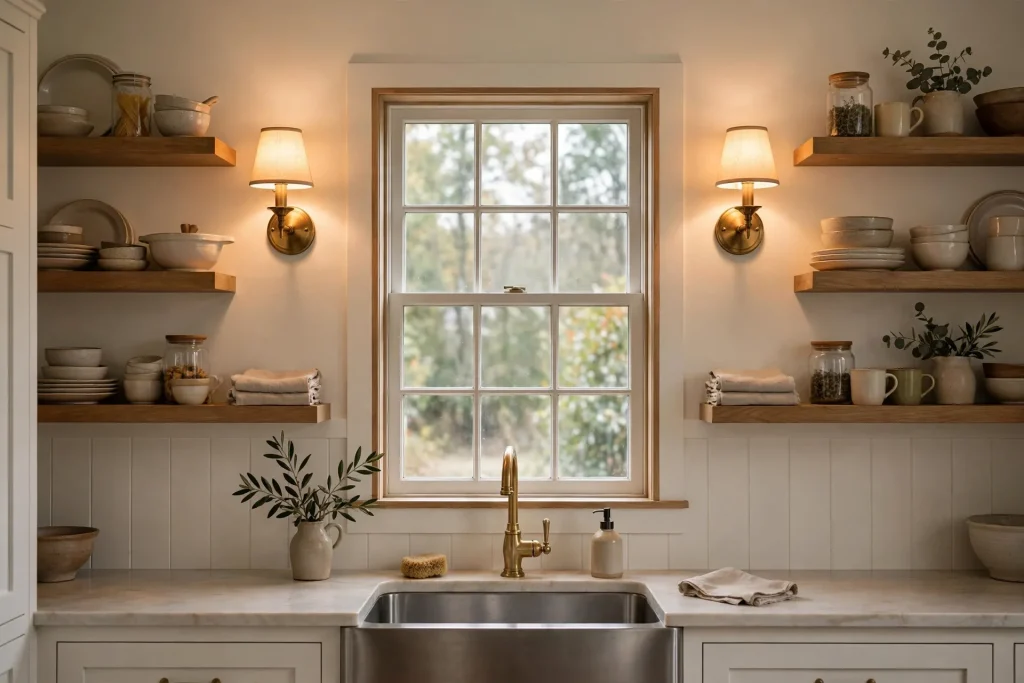
A swing-arm or fixed sconce above the sink lights up the dishes without someone’s head blocking a ceiling light. Over open shelving, a pair of small sconces turns plain plates and jars into a pretty display.
Picture two brass sconces with white glass shades above a farmhouse sink, with a window in between. During the day, sunlight does the work. In the evening, the sconces glow softly and make the whole wall feel warm.
Fixtures near the sink may need a damp or wet location rating, depending on how much moisture and splashing they’ll actually face and your local electrical requirements. Check the label and the manufacturer’s clearance guidance, and have an electrician wire it if it isn’t plug-in.
Ambient lighting: the overall glow (three ideas):
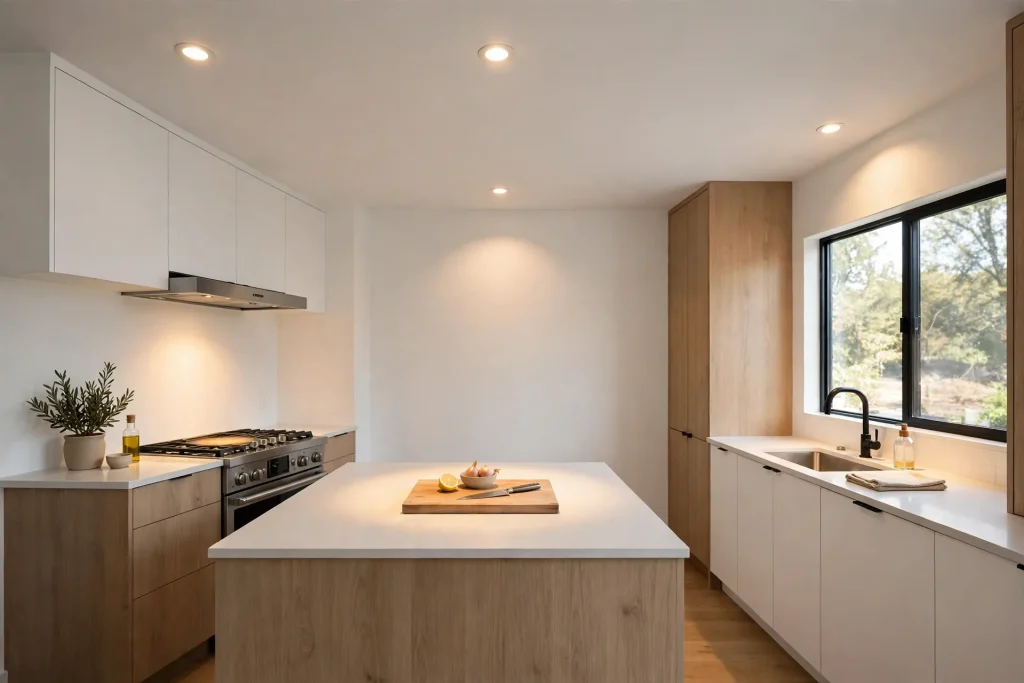
Recessed Downlights Planned Around Work Zones
Recessed lights, sometimes called can lights or downlights, give clean, even light without cluttering the ceiling.
The trick is placement. Many kitchens have them in neat rows in the middle of the room, which puts light behind you while you work. Your body then casts a shadow on the counter.
A better approach:
Place downlights roughly above the front edge of the counters, so light falls in front of you rather than behind. Many kitchens end up with spacing somewhere around 4 to 6 feet (1.2 to 1.8 m), but the right distance depends on ceiling height, beam angle, light output, and your layout.
Slim LED wafer lights are a good choice for remodels, since they need less ceiling depth than traditional cans. A lighting designer or electrician can help work out spacing for your specific room.
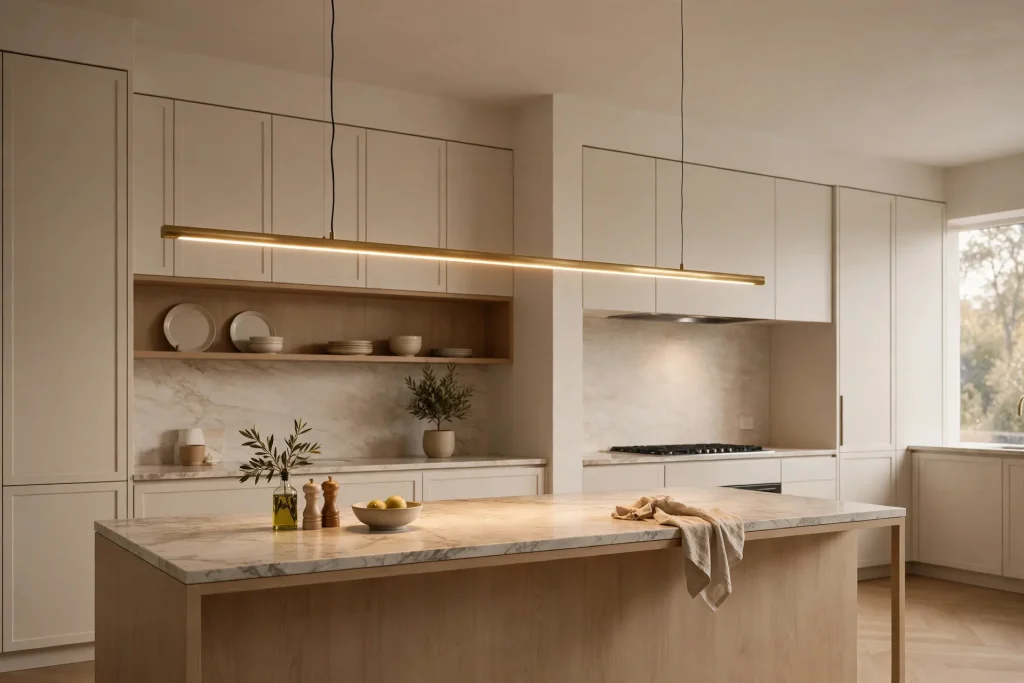
A Linear Suspension Light
A linear suspension light is one long fixture that hangs over an island or dining table, instead of a row of separate pendants.
It looks clean, modern, and works especially well over long islands where three or four pendants might feel busy.
Some linear lights shine both up and down. The downward light helps with tasks, while the upward glow bounces off the ceiling and softens the whole room.
Good to know: measure your island before buying. A linear light usually looks best when it’s about two-thirds the length of the surface below it, though that’s a guideline rather than a rule.
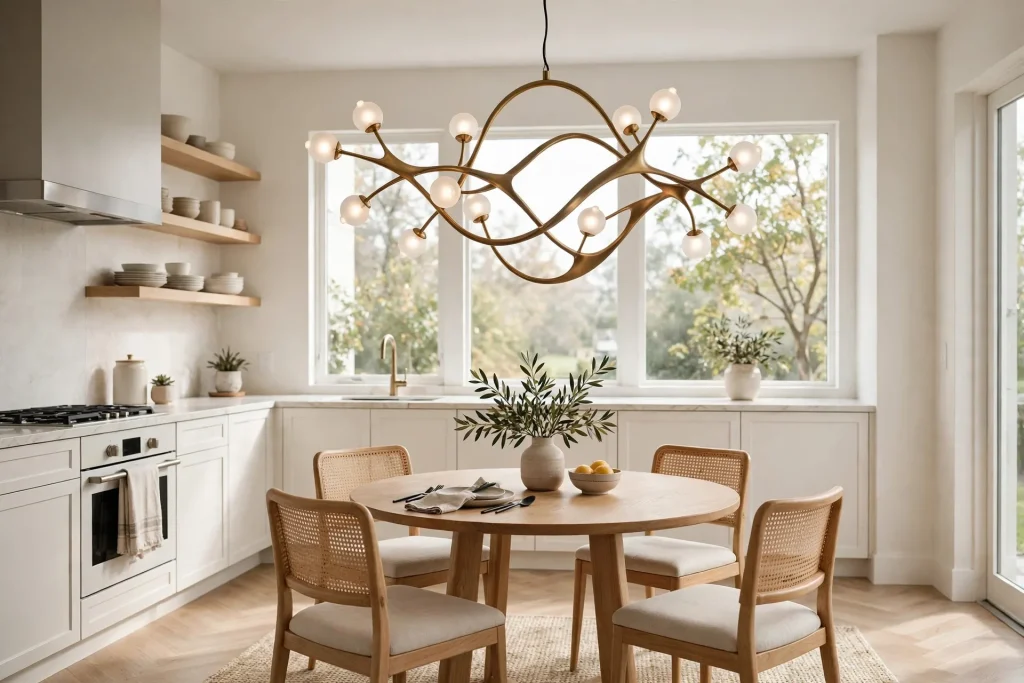
A Statement Fixture Over the Breakfast Nook
If your kitchen has a small dining area or breakfast nook, give it its own light.
A chandelier, oversized paper lantern, or sculptural pendant over the table separates the eating zone from the cooking zone. It also makes casual meals feel a bit more special.
Styles to consider:
- A woven rattan pendant for a relaxed, natural feel
- A classic brass chandelier with candle-style bulbs
- A large paper or fabric lantern for soft, diffused light
- A cluster of small glass globes for a playful look
Hang it about 30 to 36 inches (75 to 90 cm) above the tabletop, and put it on a dimmer. Then you can turn it down for dinner and up for homework or puzzles.
Accent lighting and easy upgrades (three ideas):
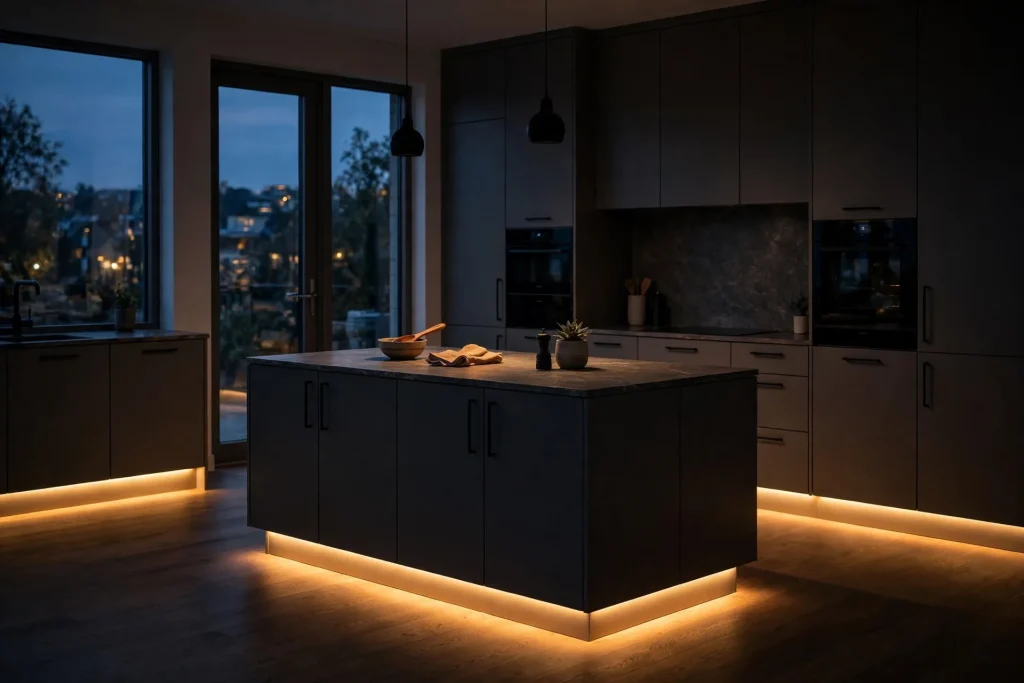
Toe-Kick Lighting
Toe-kick lighting runs along the recessed strip at the base of your lower cabinets. It throws a soft glow across the floor.
It might sound like a luxury, but it’s surprisingly practical. Turn it on at night, and you can grab a glass of water without blasting the overhead lights.
It also makes cabinets look like they’re floating, which adds a modern, high-end feel. Warm white works best here, since a soft, low glow is far more pleasant at 2 a.m. than a bright, cool strip of light.
Motion-sensor versions switch on automatically when someone walks in, which is handy for families and late-night snackers. Place the sensor where it reliably catches people entering, but not where a pet or a passing hallway light will keep triggering it. Battery-powered sensor strips are an easy option if you don’t want new wiring.
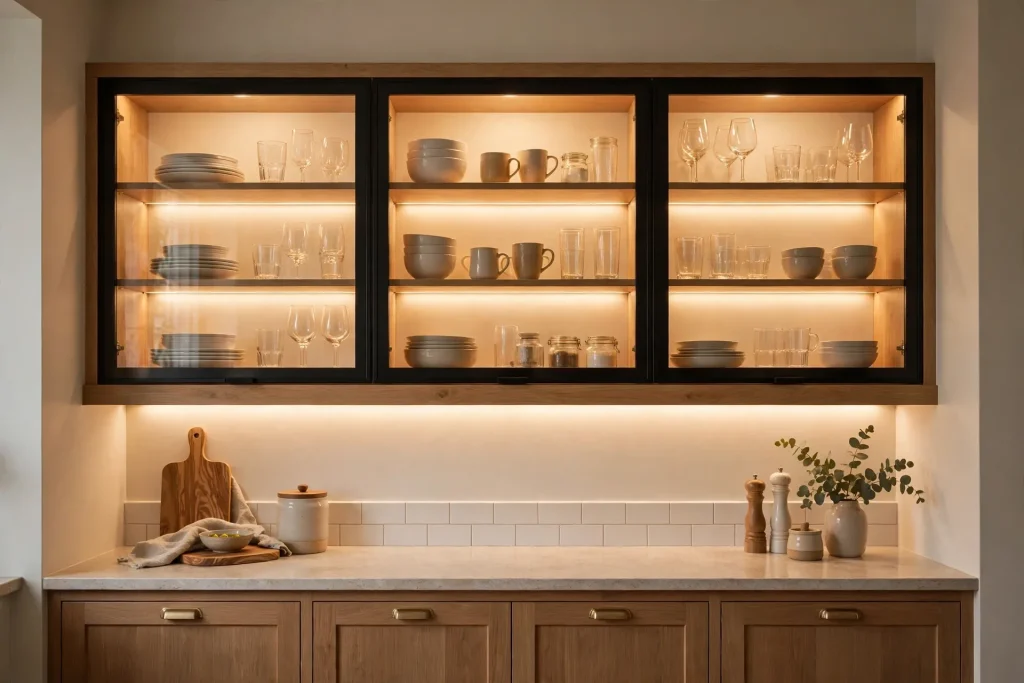
Lighting Inside Glass-Front Cabinets
Glass-front cabinets are lovely, but at night they often look like dark boxes.
Adding small LED strips or puck lights inside turns them into a soft display. Your glassware, ceramics, or favorite cookbooks suddenly become a feature.
A few tips:
- Use glass shelves if possible, so light can pass down through every level
- Choose warm-toned LEDs to avoid a cold, clinical look
- Keep the display simple, with space between items
Even if you don’t have glass doors, the same idea works on open shelves. A strip of light under each shelf highlights what’s below.
Plug-In and Rechargeable Lights for Renters
You don’t have to own your home to have great kitchen lighting.
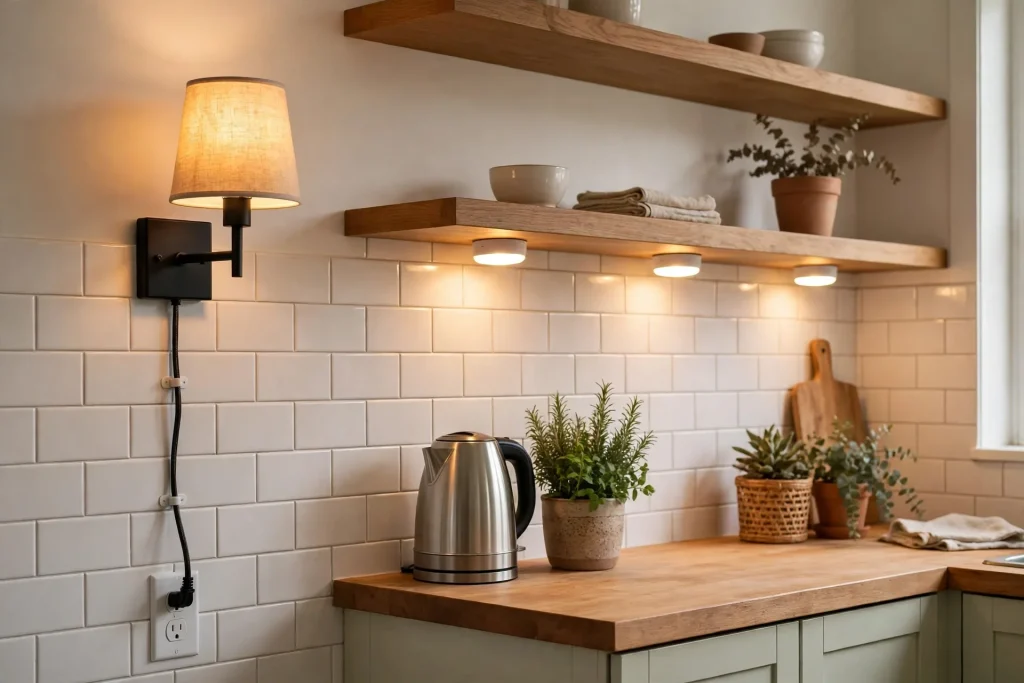
Renters can make a big difference with fixtures that don’t need wiring. Here are a few options worth exploring:
- Plug-in sconces that mount with a couple of screws or an adhesive system, with a cord cover to keep things tidy
- Rechargeable puck lights that stick under cabinets or inside shelves
- Cordless table lamps for the counter, which add a cozy glow in the evening
- Smart bulbs in existing fixtures, so you can change brightness and warmth from your phone
A small cordless lamp in a corner of the counter is one of the easiest ways to make a kitchen feel lived-in and welcoming. Just keep it away from the sink and stove, and remember to recharge it every few days or weeks, depending on use.
Always check your lease before drilling, and use removable adhesive where possible.
How the Layers Work Together
Here’s how one kitchen might use them over a normal day:
Morning: recessed lights and under-cabinet strips on full for making breakfast and packing lunches.
Afternoon: natural light from the window, with island pendants on for homework.
Evening: pendants and the nook chandelier dimmed for dinner, with glass cabinet lights glowing in the background.
Late night: just the toe-kick lights, so nobody gets blinded on the way to the fridge.
Separate switches or smart controls make this easy. Ask your electrician to put each layer on its own circuit if you’re renovating.
Small Kitchen Lighting Ideas That Make a Difference
Small kitchens benefit from good light even more than big ones, since shadows make a tight space feel even smaller.
Go slim. Low-profile flush or semi-flush fixtures keep the ceiling clear, especially if it’s low.
Light the walls. Sconces and under-cabinet strips wash light across vertical surfaces, which makes the room feel wider.
Use reflective surfaces. A glossy backsplash or light-colored cabinets bounce light around.
Pick one statement piece. In a small kitchen, a single interesting pendant usually looks better than several competing fixtures.
Matching Fixtures to Your Kitchen Style
The finish and shape of a fixture can tie the whole room together.
Modern kitchens: matte black, brushed nickel, and simple geometric shapes like cylinders and linear bars.
Farmhouse kitchens: aged brass, enamel shades, and seeded glass.
Warm, natural kitchens: rattan, linen shades, and wood details.
Classic kitchens: polished nickel, lantern shapes, and opal glass.
You don’t need every fixture to match. Many designers pick one main finish and repeat it two or three times, such as in the pendants, cabinet hardware, and faucet. Even simple kitchen lighting ideas look more polished when the finishes feel connected.
A Real Kitchen Makeover Example
Imagine a small galley kitchen with one flush-mount ceiling light and white cabinets. It feels flat and slightly gloomy, especially in winter.
What changes:
- Rechargeable LED strips stick under the front edge of the upper cabinets on both sides, so each counter run is lit where you prep
- The bulb in the existing ceiling light is swapped for a warm 2700K LED with a high CRI
- A small cordless lamp sits at the far end of the counter beside the coffee maker, well away from the sink and stove
No rewiring, no major cost. Yet the counters are now evenly lit, the room feels warmer, and the coffee corner looks cozy in the morning.
Kitchen Lighting Mistakes to Avoid
Relying on one central fixture. It almost always leaves shadows on the counters.
Mixing bulb colors. A cool 5000K bulb next to a warm 2700K one looks mismatched. Try to keep color temperatures consistent.
Hanging pendants too high or too low. Too high, and they lose impact. Too low, and you’ll bump your head or block the view.
Forgetting dimmers. Without them, your kitchen is either fully bright or fully dark.
Ignoring glare. Glossy countertops and exposed bulbs can create harsh reflections. Diffusers and well-placed fixtures help.
Skipping safety checks. Choose fixtures rated for their location, follow the manufacturer’s installation instructions and clearances, check local electrical requirements, and hire a licensed electrician for hardwired work, especially around sinks and cooking areas.
Questions About Kitchen Lighting
What is the best lighting for a kitchen?
A mix of task, ambient, and accent lighting usually works best. Under-cabinet strips, recessed lights, and pendants are a popular combination.
What color temperature is best for kitchens?
Many people prefer 2700K to 3000K for a warm, inviting feel. Some choose around 3500K to 4000K for a brighter, crisper look over work areas.
How high should pendant lights hang over an island?
A common guideline is about 30 to 36 inches (75 to 90 cm) from the countertop to the bottom of the pendant.
How can renters improve kitchen lighting?
Try plug-in sconces, rechargeable under-cabinet lights, cordless lamps, and smart bulbs. They add light without permanent changes.
Are LED lights good for kitchens?
Yes. LEDs use less energy, last a long time, and stay cooler than older bulbs, which makes them a practical choice for most kitchen lighting ideas.
Start With the Shadow
The best kitchen lighting ideas start with one simple question: where do you need light that you don’t have right now?
For most people, it’s the counter. Fix that first with under-cabinet lighting, then build from there with pendants, dimmers, and a soft glow for the evening. Little by little, your kitchen will feel brighter, more practical, and much more inviting.